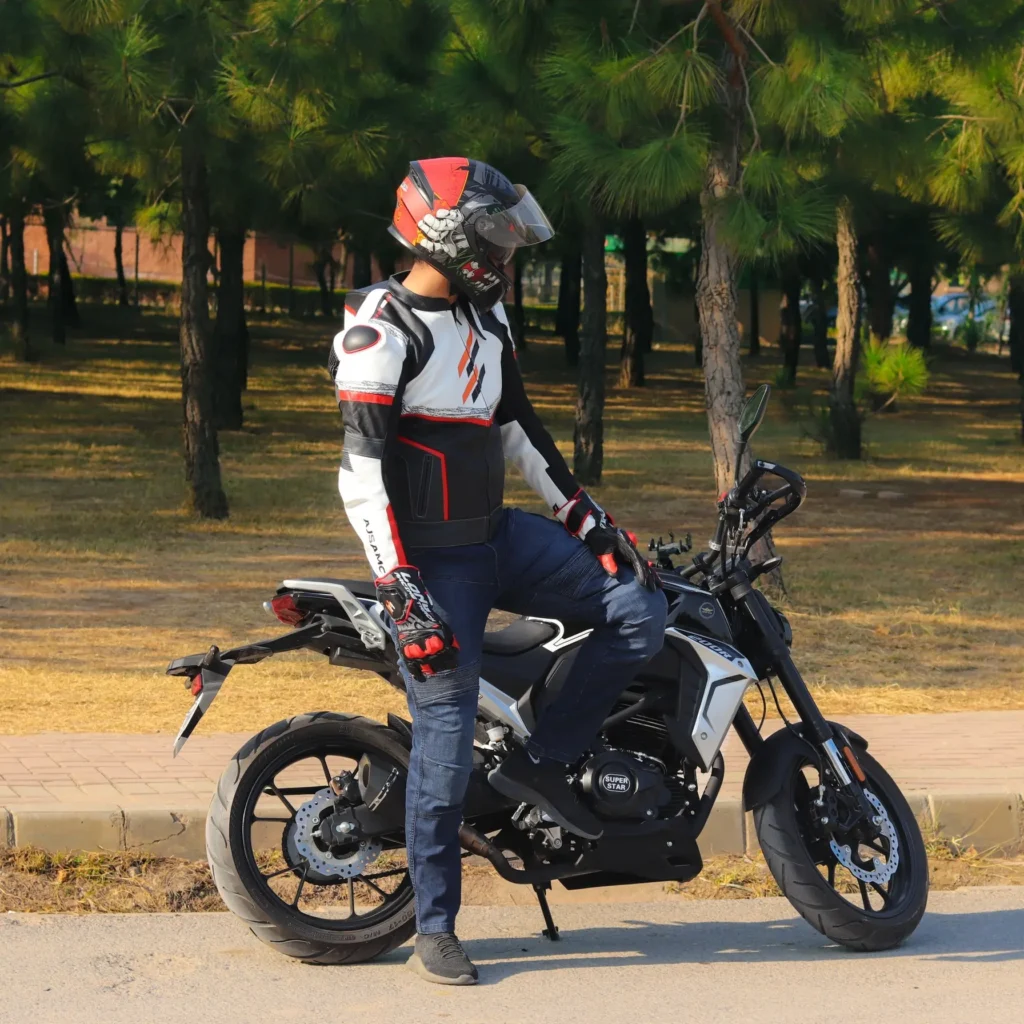
A motorcycle racing suit is the most technically demanding garment in the motorcycle apparel category. One-piece construction, AAA CE certification, kangaroo or cowhide leather throughout, integrated back protector, connection zips for gloves and boots — the specification document for a racing suit is significantly more complex than for a touring jacket or a textile commuter garment.
Brands that come to manufacturers with an incomplete specification lose weeks on back-and-forth clarification and often end up with first samples that miss critical details. This guide covers every element a complete racing suit specification should include — written from the factory perspective of what information we actually need to quote accurately and produce correctly.
Why a Complete Spec Matters More for Racing Suits
Racing suits have tighter tolerances than any other motorcycle garment. The garment must fit correctly in the riding position — aggressive forward lean, arms extended to bars, knees on tank. The CE AAA certification requires full-body coverage with specific armour placement. The construction must pass abrasion, impact cut, and seam strength tests at the highest level of EN 17092.
An incomplete spec on a touring jacket produces a sample that needs adjustment. An incomplete spec on a racing suit can produce a sample that fails CE coverage requirements, fits incorrectly in the riding position, or has armour pockets in the wrong position for the body type it is designed for. These are not cosmetic issues — they require a fundamental redesign, not a simple alteration.
The Complete Racing Suit Specification
1. Target CE Protection Class
State explicitly: Class AAA, AA, or A. For racing suits, this will almost always be AAA. If the suit is intended for both track use and road legality in Europe, confirm that AAA certification under EN 17092-4 (one-piece suits) is the target.
2. Primary Shell Material
Specify:
- Material type: full-grain cowhide, goatskin, sheep leather, buffalo, or combination
- Thickness in mm (e.g., 1.2mm cowhide for the main body, 0.8mm kangaroo for panels)
- Tanning type: chrome-tanned, vegetable-tanned, or combination
- Colour: Pantone reference or RAL colour, not descriptive names
- Finish: matte, gloss, wax, perforated, embossed
If different materials are used in different zones (common in premium suits where a heavier hide is used in high-abrasion zones and a lighter one in stretch zones), specify the zone map clearly. A sketch or annotated image is acceptable; a written description zone by zone is not clear enough for production.
3. Stretch Panel Specification
Racing suits typically incorporate stretch panels at the knee, crotch, underarm, and sometimes back. Specify:
- Panel location (zone map or annotated image)
- Stretch material: Spandex blend, elasticated leather, stretch Cordura
- Colour and finish of stretch panels
- Whether stretch panels are in CE impact zones (if so, they must still meet the abrasion requirement for that zone)
4. Lining Specification
Racing suits typically have a full lining plus a removable inner liner for thermal comfort. Specify:
- Outer shell lining: material, weight, colour
- Inner liner attachment method: zip, popper, or full removable unit
- Inner liner material and any insulation specification
- Ventilation liner panels if applicable
5. Armour Specification
This is the most frequently incomplete section of racing suit specifications. Specify:
- Shoulder armour: certification level (EN 1621-1 Level 1 or Level 2), brand preference if any, pocket dimensions
- Elbow armour: same as above
- Knee armour: certification level (EN 1621-1 Level 1 or Level 2), pocket dimensions, position on leg
- Hip armour: specification and whether integrated or in removable pockets
- Back protector: EN 1621-2 Level 1 or Level 2, pocket position, dimensions, brand preference
- Chest protector: if specified, EN 1621-3 or EN 13158 as applicable
For AAA certification, back protection at EN 1621-2 Level 1 minimum is required. Level 2 is strongly recommended for track use and is increasingly expected by retailers.
6. Hardware Specification
Every hardware element that appears in the finished garment must be specified:
- Front zip: brand (YKK, Riri, Lampo), gauge, colour, length
- Chest vents: zip type, colour, number
- Arm vents: same as above
- Glove connection zip: specification, position on wrist cuff
- Boot connection zip: specification, position on ankle cuff
- Emergency zip on rear shoulder (if required for medical access)
- Snaps: specification and placement
- Velcro: specification and placement (width, colour, loop vs hook face on which layer)
7. Stitching and Seam Specification
For AAA certification, seam construction in impact zones is critical. Specify:
- Thread specification: polyester, nylon, or bonded nylon; weight (ticket number)
- Stitch density: stitches per cm in impact zones and non-impact zones
- Seam type: lap seam, flat seam, or outseam in each zone
- Double or triple stitching requirements in specific zones
- Visible topstitch colour if different from main thread
8. Branding Elements
Specify every branding element in the garment:
- Main brand label: position, attachment method, material, artwork file format
- CE label: position and content (the standard defines required content)
- Care label: position and symbols
- Embroidery: position, size, thread colour specification, artwork file
- Printed or bonded logos: position, size, material specification, artwork file
- Reflective panels or piping: position and specification
9. Size Grading
Provide a full size grading table covering all measurement points:
- Chest circumference
- Waist circumference
- Hip circumference
- Seat depth
- Arm length
- Inseam length
- Back length
- Shoulder width
EN 17092 defines CE coverage zones based on body measurements. Your grading table must ensure that armour pocket positions in every size maintain required coverage for that size. Grading the armour pockets correctly across sizes is one of the most technically demanding aspects of racing suit pattern development.
10. Packaging and Presentation
Specify how the finished garment should be presented for shipment:
- Folded or hung
- Individual polybag specification
- Hangtag specification if applicable
- Outer carton specification
- Units per carton
- Labelling requirements on outer cartons
What Happens When the Spec Is Incomplete
When we receive an incomplete specification at AJSAMCO, we can proceed in one of two ways: we can fill in missing details based on our standard construction for that garment type, or we can go back to the brand with a list of questions. The first approach produces a faster sample but may not match what the brand intended. The second approach is slower but produces a sample that reflects the brand's actual requirements.
For racing suits, we always recommend the second approach. A racing suit with the wrong armour pocket position, incorrect seam specification in an impact zone, or a glove connection zip in the wrong position cannot be corrected with a simple alteration — it requires a pattern revision and a new sample.
The time invested in completing the specification document before first contact with the factory saves weeks in the development process and significantly reduces sampling costs.
AJSAMCO can work with brands to develop specifications from a concept, from a reference garment, or from a partial technical document. If you are developing a racing suit and want to discuss the specification before sampling, contact us directly or request our product catalogue to see our current racing suit range as a starting reference.